
CONTOUR IP HOLDING, LLC v. GOPRO, INC, Federal Circuit 2018 (Software Patents)
Is a GoPro too Abstract to be Patentable?
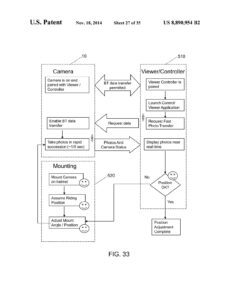 Contour IP Holding LLC owns U.S. Patent Nos. 8,890,954 and 8,896,694. The two patents share virtually identical specifications. Contour sued GoPro for patent infringement. According to Contour, several of GoPro’s point-of-view digital video camera products infringed its patents. POV video cameras are often used to capture a scene from a user’s point-of-view rather than from a thirdperson viewpoint. The patents disclose a hands-free, POV action sports video camera configured for remote image acquisition control and viewing. A POV camera is one that is mounted in a location that does not permit the user to easily see the camera. A skier, for example, may wish to mount a small POV camera to a helmet. In these instances, the user is unable to review what is being recorded in real time on the camera or to adjust settings. To address these problems, the patents describe implementing wireless technology in the video camera 10 that allows the camera to send real time information to a remote device, such as a cell phone. The patents also disclose a camera that is configured to generate video recordings “in two formats, high quality and low quality, in which the lower quality file is streamed to the remote device.
Procedural History of Contour IP Holding, LLC v. GoPro, Inc.
After years of litigation, GoPro sought summary judgment on grounds that Contour’s asserted claims were patent ineligible under 35 U.S.C. § 101. The district court agreed with GoPro and entered judgment against Contour.
Claim 11 of Contour IP Holding, LLC v. GoPro, Inc.
Claim 11 is representative and recites:
11. A portable, point of view digital video camera, comprising:
- a lens;
- an image sensor configured to capture light propagating through the lens and representing a scene, and produce real time video image data of the scene;
- a wireless connection protocol device configured to send real time image content by wireless transmission directly to and receive control signals or data signals by wireless transmission directly from a personal portable computing device executing an application; and
- a camera processor configured to:
- receive the video image data directly or indirectly from the image sensor,
- generate from the video image data a first image data stream and a second image data stream, wherein the second image data stream is a higher quality than the first image data stream,
- cause the wireless connection protocol device to send the first image data stream directly to the personal portable computing device for display on a display of the personal portable computing device, wherein the personal portable computing device generates the control signals for the video camera, and wherein the control signals comprise at least one of a frame alignment, multi-camera synchronization, remote file access, and a resolution setting, and at least one of a lighting setting, a color setting, and an audio setting,
- receive the control signals from the personal portable computing device, and
- adjust one or more settings of the video camera based at least in part on at least a portion of the control signals received from the personal portable computing device.
The district court concluded that the claim recites only functional, results-oriented language with no indication that the physical components are behaving in any way other than their basic, generic tasks.
In reviewing the decision of the district court, the Federal Circuit applied the two-step “Alice” test. Under Alice step one, we consider whether the claims at issue are directed to an abstract idea. If the claims are not directed to an abstract idea, the Alice inquiry ends. If the claims are directed to patent ineligible subject matter, the inquiry continues to Alice step two, where we ask whether the claims recite something “significantly more” than an abstract idea itself.
According to the Federal Circuit, claim 11 is directed to a specific means that improves the relevant technology. Claim 11 recites an improved POV camera through its combination of claim limitations and requirement that the claimed POV camera processor be configured to record low and high-quality data streams in parallel, followed by the low-quality data stream’s wireless transfer to a remote device. With the claimed POV camera, a user can remotely view and adjust the desired recording in real time, with the elimination of bandwidth limitations on wireless data transfer. The claims thus require specific, technological means—parallel data stream recording with the low-quality recording wirelessly transferred to a remote device—that in turn provide a technological improvement to the real time viewing capabilities of a POV camera’s recordings on a remote device.
The Federal Circuit found it important that “generate” in claim 11 requires recording multiple video streams “in parallel” based on the district court’s claim construction.
According to the Federal Circuit, the district court’s decision characterized the claims at an impermissibly high level of generality. The practice of “describing the claims at such a high level of abstraction and untethered from the language of the claims all but ensures that the exceptions to § 101 swallow the rule” according to the Federal Circuit’s Enfish decision. For example, in this case, the district court’s conclusion that the claims were “directed to a result or effect that itself is the abstract idea” disregards the disclosed technological means for obtaining a technological result. According to the Federal Circuit, the district court erred in its generalized articulation of the claimed advance of the claims, which all but ensured the incorrect conclusion that the claims were drawn to an abstract idea.
Unfortunately, how high of a level of generality is permissible is unclear. The exception seems to mostly have swallowed the rule. The parallel data streams could just as easily have been seen to have been abstract, depending on who was deciding the case. Luckily for GoPro, they survived the Summary Judgement motion in this case, on appeal. Unfortunately for them, it took years of litigation to get to this stage. When dealing with software inventions, it is important to consider other forms of intellectual property protection in addition to software patents. Companies should also consider design patents, copyright, and trade secret law, where appropriate.