
BROADBAND ITV, INC. v. AMAZON.COM, INC., Federal Circuit 2024 (Software Patents)
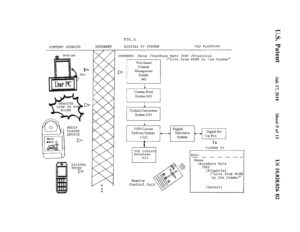 Broadband iTV sued Amazon in the Western District of Texas alleging patent infringement of five patents relating to user interfaces. Amazon moved for summary judgment, arguing that all asserted claims were patent ineligible subject matter under 35 U.S.C. § 101. The district court granted Amazon’s motion, finding the claims were directed to an abstract idea and the patents failed to provide an inventive step that transformed that abstract idea into a patent-eligible invention. Four of the patents are related: U.S. Patent Nos. 10,028,026 (’026 patent); 9,648,388 (’388 patent); 10,536,750 (’750 patent); and 10,536,751.
The ’026 patent and its related family generally relates to electronic programming guides for televisions. “Video-on-demand” systems offered an “interactive television service” by allowing a viewer to navigate through a program guide using a remote control and select a desired video program. The ’026 patent family seeks to improve existing program guides by automating the creation of a hierarchically arranged, template-based program guide. A computer automatically creates the program guide by using video content and associated metadata that content providers upload to a server.
Claim 1 of U.S. Patent No. 10,028,026 is representative and recites:
1. An Internet-connected digital device for receiving, via the Internet, video content to be viewed by a subscriber of a video-on-demand system using a hierarchically arranged electronic program guide,
the Internet-connected digital device being configured to obtain and present to the subscriber an electronic program guide as a templatized video-on-demand display, which uses at least one of a plurality of different display templates to which the Internet-connected digital device has access, to enable a subscriber using the Internet-connected digital device to navigate in a drill-down manner through titles by category information in order to locate a particular one of the titles whose associated video content is desired for viewing on the Internet-connected digital device using the same category information as was designated by a video content provider in metadata associated with the video content;
wherein the templatized video-on-demand display has been generated in a plurality of layers, comprising: (a) a first layer comprising a background screen to provide at least one of a basic color, logo, or graphical theme to display; (b) a second layer comprising a particular display template from the plurality of different display templates layered on the background screen, wherein the particular display template comprises one or more reserved areas that are reserved for displaying content provided by a different layer of the plurality of layers; and (c) a third layer comprising reserved area content generated using the received video content, the associated metadata, and the associated plurality of images to be displayed in the one or more reserved areas in the particular display template as at least one of text, an image, a navigation link, and a button,
wherein the navigating through titles in a drill-down manner comprises navigating from a first level of the hierarchical structure of the video-on-demand content menu to a second level of the hierarchical structure to locate the particular one of the titles, and
wherein a first template of the plurality of different display templates is used as the particular display template for the templatized display for displaying the first level of the hierarchical structure and wherein a second template of the plurality of different display templates is used as the particular display template for the templatized display for displaying the second level of the hierarchical structure,
wherein the received video content was uploaded to a Web-based content management system by a content provider device associated with the video content provider via the Internet in a digital video format, along with associated metadata including title information and category information, and along with an associated plurality of images designated by the video content provider, the associated metadata specifying a respective hierarchical location of a respective title of the video content within the electronic program guide to be displayed on the Internet-connected digital device using the respective hierarchically-arranged category information associated with the respective title,
wherein at least one of the uploaded associated plurality of images designated by the video content provider is displayed with the associated respective title in the templatized video-on-demand display.
The district court determined the claims of the ’026 patent family “are directed to the abstract idea of receiving hierarchical information and organizing the display of video content.” BBiTV argues that the ’026 patent family claims are directed to patentable improvements to computer user interfaces, and that the district court erred by dismissing claim elements it found to be generic at Alice step one rather than step two. The Federal Circuit disagreed with BBiTV.
Alice/Mayo Two Step Framework
At Alice step one, it must determined whether the claims at issue are directed to patent-ineligible subject matter, here, an abstract idea.
The claims of the ’026 patent family are directed to receiving metadata and organizing the display of video content based on that metadata. Representative claim 1 of the ’026 patent recites an “electronic program guide” that is automatically created using “metadata” that was “uploaded to a [server] by a content provider.” According to the ’026 patent, an increase in content offerings created the need to “enable home TV viewers to find something of interest for viewing among the vast numbers of new programs.” In response, the ’026 patent’s claimed advance is using a computer to generate a programming guide that automatically “list[s] the title of the video content in an electronic program guide” according to metadata uploaded by a content provider.
The Federal Circuit stated that the district court correctly determined that receiving metadata and organizing the display of video content based on that metadata is abstract.
BBiTV’s first argument relied heavily on Core Wireless and another case in which a user interface patent was found to be patent-eligible.
In Core Wireless, the Federal Circuit held that claims directed to a “particular manner of summarizing and presenting information in electronic devices” were not abstract. The Federal Circuit explained that the claims at issue there were directed to the features of an improved user interface, including the size and location of the user interface. In Data Engine, the Federal Circuit held that claims directed to a “specific method for navigating through three-dimensional electronic spreadsheets” were not abstract. There, the patent’s specification identified the shortcomings and technological challenges in computer spreadsheets, and the claims provided a specific solution to the “known technological problem.”
Unlike the claims in Core Wireless, the ’026 patent family claims are not directed to an improved structure or function of a user interface. It is true that the claims are directed to a program guide, which is a type of user interface. But the fact that the claims involve a user interface does not automatically put the claims in the same category as Core Wireless. Instead, Core Wireless requires an improved structure or function that is missing here. Put another way, Core Wireless require a specific, technological solution to a technological problem. Here, the claims do not recite an improved structure or function within a user guide, but rather, are directed to arranging content in a particular order. Reordering content within a user guide is not a sufficient technological solution to a technological problem, but rather a results-oriented abstract idea.
BBiTV argued that the claimed templates provide specific structure similar to Core Wireless and Data Engine. We disagree. While claim 1 does recite a “templatized” video-on-demand display that consists of three layers, the use of templates to create the electronic programming guide is not the claimed advance. Instead, as previously discussed, the claims are directed to receiving metadata and organizing the display of video content based on that metadata. The claimed templates themselves do not provide a technological solution or improve any computer-related function.
BBiTV’s second argument is that the district court performed an Alice step two inquiry within Alice step one. The Federal Circuit discerned no error in the district court’s analysis.
The Federal Circuit has observed that steps one and two are “plainly related” and patent eligibility may “involve overlapping scrutiny of the content of the claims.” But the Federal Circuit has recognized that it may be necessary to analyze conventionality at step one as well as step two, such as to determine whether a claim is directed to a longstanding or fundamental human practice or to determine what the patent asserts is the claimed advance over the prior art. Then, still at step one, the district court considered the claimed “templates,” and determined they merely provided “a generic environment” and their use is “a routine and conventional practice.” The Federal Circuit agreed that the claimed server and templates do not change the fact that the claims are directed to an abstract idea. The claimed server and templates do not change the outcome at step one because the claims are not directed to an improved server or provide a technological solution to template technology. Put another way, analyzing the conventionality of the claimed content management system and templates at step one is proper for the purpose of determining what the claims are directed to. The Federal Circuit determined that the claims of the ’026 patent family are directed to an abstract idea.
At Alice step two, BBiTV pointed to three aspects of the claims that it believes transform the claims to more than the abstract idea: first, the idea of generating displays “automatically from specific template types” based on data that content providers upload to a database; second, the content management system which is a type of server; and third, the claimed templates. The Federal Circuit agreed with the district court that none of these elements transform the claims at step two into something other than the abstract idea itself.
BBiTV argued that the idea of generating displays “automatically from specific template types” based on data that content providers upload to a database transforms the ’026 patent family into more than the abstract idea. The Federal Circuit was not persuaded. Automation of an abstract idea does not constitute an inventive concept.
BBiTV next argued that the content management system transforms the ’026 patent family into more than the abstract idea. This argument fared no better than the last. The district court concluded that the content management system is a conventional server. The Federal Circuit agreed with the district court.
BBiTV’s third argument is that the claimed templates transform the claims to more than the abstract idea. We are not persuaded. The district court found no genuine dispute of material fact (albeit, at step one), that the claimed templates are generic, routine and well-understood in the art. The ’026 patent’s specification does not purport to improve templates, but instead discloses using known templates, such as those created by a “template design firm,” to automate content-creation. In reaching its conclusion, the district court also considered BBiTV’s infringement expert’s admission that templates “were a known entity” at the time of the invention. The Federal Circuit agreed with the district court’s conclusion. When properly analyzed at step two, they reached the same conclusion as the district court and determine that the claimed templates do not transform the claims to more than the abstract idea.
It is a fine line of difference between this case and Core Wireless. All user interfaces present and arrange information in a certain order. I suppose that there was a greater level of detail in Core Wireless. It is important to present the problem solved as a technological problem, to somehow assert that the hardware was improved if that is at all possible. It should not be assumed that all user interfaces are patent-eligible.
In view of the risk of patent eligibility, a designer of a unique user interface should always consider design patents and copyright registrations in case their utility patents are eventually found to be invalid.