
MILLER MENDEL, INC. v. CITY OF ANNA, TEXAS, FEDERAL CIRCUIT 2024 (SOFTWARE PATENTS)
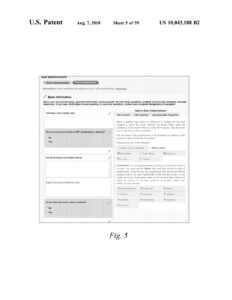 Miller Mendel, Inc. sued the City of Anna, Texas for patent infringement regarding a software system for background investigations, but the district court ruled the patent claims ineligible under 35 U.S.C. § 101.
Miller Mendel alleged infringement of U.S. Patent No. 10,043,188 relating to pre-employment background checks. Claim 1 is representative and recites:
- A method for a computing device with a processor and a system memory to assist an investigator in conducting a background investigation of an applicant for a position within a first organization, comprising the steps of:
- receiving a first set of program data comprising information identifying the applicant, the position, the first organization, and the investigator;
- storing a new applicant entry in the system memory, the new applicant entry associated with the first set of program data;
- transmitting an applicant hyperlink to an applicant email address associated with the applicant, the applicant hyperlink for viewing an applicant set of electronic documents;
- receiving an applicant electronic response with a reference set of program data, wherein the reference set of program data comprises information regarding a reference source, wherein the reference source is a person, the program data including a reference email address associated with the reference source;
- determining a reference class of the reference source based on the reference set of program data;
- selecting a reference set of electronic documents based on the reference class of the reference source;
- transmitting a reference hyperlink to the reference email address, the reference hyperlink for viewing the reference set of electronic documents;
- receiving a reference electronic response to the reference set of electronic documents from the reference source;
- storing the reference electronic response in the system memory, associating the reference electronic response with the new applicant entry; and
- generating a suggested reference list of one or more law enforcement agencies based on an applicant residential address.
The district court granted the City’s motion for judgment on the pleadings, concluding the claims were not patent-eligible.
Legal Standards and Review Process
The appeals court reviews the district court’s judgment on the pleadings de novo.
Arguments and Findings on Patent Eligibility
The appeals court upheld the district court’s finding that the asserted claims of the patent were directed to an abstract idea and thus not patent-eligible.
Alice/Mayo Two Step Framework
Regarding patent eligibility, the court applied the two-step Alice/Mayo framework. At Alice/Mayo step one, the Federal Circuit is to “determine whether the claims at issue are directed to one of those patent-ineligible concepts,” such as an abstract idea. To determine whether a claim is “directed to” a patent ineligible concept, “we look to whether the claims ‘focus on a specific means or method that improves the relevant technology or are instead directed to a result or effect that itself is the abstract idea and merely invoke generic processes and machinery. Here, the claim language shows that the claimed invention is directed to the abstract idea of performing a background check. The claim also recites several steps that the computer system performs to assist the investigator with conducting a background investigation. These steps demonstrate that the claims are directed to receiving, storing, transmitting, determining, selecting, and generating information, which place them in the “familiar class of claims directed to a patent-ineligible concept.”
The patent specification confirms that the asserted claims are directed to an abstract idea. The ’188 patent states that the problem addressed by the invention is “to help a background investigator more efficiently and effectively conduct a background investigation.” The specification also refers to the subject matter of the invention as “a web based software system for managing the process of performing pre-employment background investigations.”
Miller Mendel tried relying on Enfish, LLC v. Microsoft Corp., 822 F.3d 1327, 1337–38 (Fed. Cir. 2016), arguing that the district court overlooked clear improvements offered by the asserted claims. The Federal Circuit found this argument to also be unpersuasive. In Enfish, the claims were directed to “a specific type of data structure designed to improve the way a computer stores and retrieves data in memory.” Because the asserted claims of the ’188 patent are not directed to an improvement in computer technology, Enfish is distinguishable. In sum, at Alice/Mayo step one, the asserted claims are directed to an abstract idea.
At Alice/Mayo step two, the Federal Circuit found that the asserted claims do not contain additional elements that “transform the nature of the claim into a patent-eligible application.”
The big patent drafting tip here is that, when drafting a patent application, try to state that the main problem is a problem of computer technology and how to improve efficient. Of course, this wasn’t possible in advance of the Alice decision, but it is possible for patent applications drafted now.
Cross-Appeal on Invalidity Findings
The City of Anna cross-appealed, arguing that the district court should have invalidated additional claims of the patent, but the appeals court found no jurisdiction over those claims.
The district court clarified that its invalidity findings applied only to claims 1, 5, and 15.
The court determined that Miller Mendel had narrowed the scope of claims at issue to these three, thus the district court lacked jurisdiction over unasserted claims.
Conclusion of the Case
The appeals court affirmed the district court’s judgment and the denial of attorneys’ fees.
The court upheld the ruling that the software patent claims were not patent-eligible.