
BETEIRO V DRAFTKINGS, FEDERAL CIRCUIT 2024 (SOFTWARE PATENTS)
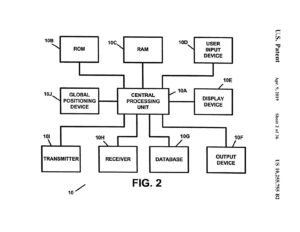 Beteiro owns U.S. Patent Nos. 9,965,920, 10,043,341, 10,147,266, and 10,255,755. All of the patents share a common specification and title: “Apparatus and Method for Facilitating Gaming Activity and/or Gambling Activity.” The patents disclose an invention which facilitates gaming activity and/or gambling activity at a gaming venue remote from the user’s or individual’s physical location” such that the user can “participate in live gaming activity and/or gambling activity via a user communication device” even if the user is not in the same location as the gaming venue. The ‘920 patent explains that many individuals enjoy gambling but may not always have access to particular gaming venues or gaming activities, for reasons including that the individuals may be located in a jurisdiction in which gambling is not lawful. As a solution, the patent describes a preferred embodiment in which a user can access a . . . gaming facility computer 30 via the user communication device 20 and place a bet, wager, and/or otherwise engage in gaming activity and/or gambling activity. The gaming facility computer 30 can determine if the remote gaming activity and/or gambling activity is allowed by the state having jurisdiction over the individual by determining the location of that individual. The patent describes ascertaining the user’s location through the use of a global positioning system (“GPS”) included in “user communication device(s).” One embodiment describes the GPS equipped on a mobile device such as a mobile phone.
Claim 2 of the ‘755 patent is representative and recites:
2. A computer-implemented method, comprising:
- detecting, with or using a computer which is specially programmed for processing information for providing for a placement of a bet on or regarding a gaming activity, a gambling activity, or a sporting event, a posting of information regarding the gaming activity, the gambling activity, or the sporting event;
- generating, with or using the computer, a notification message regarding the gaming activity, the gambling activity, or the sporting event;
- initiating, with or using the computer, a communication link with a first communication device and transmitting the notification message to the first communication device as an electronic transmission, or transmitting, from the computer, the notification message as an electronic mail message, wherein the electronic mail message is received by or received at a first communication device, wherein the first communication device is associated with an individual;
- receiving, with the computer, a bet message transmitted from the first communication device or from a second communication device, wherein the second communication device is associated with the individual, and further wherein the first communication device or the second communication device comprises a global positioning device, wherein the global positioning device determines a position or location of the first communication device or the second communication device, and further wherein the bet message contains information regarding a bet to be placed on or regarding the gaming activity, the gambling activity, or the sporting event, and information regarding the position or location of the first communication device or the second communication device; and
- determining, with or using the computer, whether the bet is allowed or disallowed using the information regarding the position or location of the first communication device or the second communication device and, if the bet is allowed, processing information for placing the bet for or on behalf of the individual, or, if the bet is disallowed, processing information for disallowing the bet.
n 2021 and 2022, Beteiro filed at least six cases in the District of New Jersey maintaining essentially identical patent infringement claims against DraftKings and others. Draftkings and the others filed Rule 12(b)(6) motions to dismiss on the grounds that the asserted patents claim nonpatentable subject matter under 35 U.S.C. § 101. The district court granted all of the motions.
The Federal Circuit agreed with the district court’s application of the Alice/Mayo test and that the claims are directed to an abstract idea and do not contain an inventive concept.
Applying the Alice v CLS Test
The Federal Circuit applied the two-step framework set forth in Mayo Collaborative Services v. Prometheus Laboratories, Inc., 566 U.S. 66, 77–80 (2012), and further detailed in Alice v. CLS. At step one, they “determine whether the claims at issue are directed to one of those patent-ineligible concepts” such as an abstract idea. At step two, they “consider the elements of each claim both individually and as an ordered combination to determine whether the additional elements transform the nature of the claim into a patent-eligible application.”
At step one, the Federal Circuit agreed with the district court that Beteiro’s claims are directed to the abstract idea of “exchanging information concerning a bet and allowing or disallowing the bet based on where the user is located.”
According to the Federal Circuit, the claims exhibit several features that are well-settled indicators of abstractness. First, the claims broadly recite generic steps of a kind frequently held to be abstract: detecting information, generating and transmitting a notification based on the information, receiving a message (bet request), determining (whether the bet is allowed based on location data), and processing information (allowing or disallowing the bet).
Second, the claims are drafted using largely (if not entirely) result-focused functional language, containing no specificity about how the purported invention achieves those results. Claims of this nature are almost always found to be ineligible for patenting under Section 101.
Third, we have several precedents in which the Federal Circuit concluded that broadly analogous claims, such as those involving methods of providing particularized information to individuals based on their locations, to be abstract. See, e.g., Affinity Labs of Tex., LLC v. DIRECTV, LLC, 838 F.3d 1253, 1258 (Fed. Cir. 2016).
Fourth, the district court was able to persuasively analogize Beteiro’s patent claims to longstanding “real-world” (“brick and mortar”) activities. A claimed method’s similarity to “fundamental . . . practices long prevalent” is yet another clue that the claims may be abstract and unpatentable. Intell. Ventures I LLC v. Symantec Corp., 838 F.3d 1307, 1314 (Fed. Cir. 2016).
Beteiro contended that the claims are not abstract, on the grounds that the claims are allegedly tied to technological improvements. In the realm of computer-related technology, such as in this case, patent claims may be non-abstract at Alice step one if the focus of the claimed advance is on an improvement in computer technologies, rather than the mere use of computers.
Gambling Patent Held Invalid
The Federal Circuit rejected Beteiro’s contention. They stated that the asserted patents involve the mere use of computers as tools and do not claim any improvement in the computer-related technology itself. As Appellees put it, the issue of remote gambling being uncommon in 2002 was not a technical problem, nor do the Asserted Claims’ invocation of technology developed by others (GPS in phones) constitute a solution.
At Alice step two, the district court found that the representative claim failed to provide an inventive concept because it achieved the abstract steps using several generic computers. The district court thus concluded that claim 2 simply describes a conventional business practice executed by generic computer components and the Federal Circuit agreed.
Using conventional hardware to solve a problem in an online context was not enough for patentability. If the inventors had gone into more detail about the logic deep inside their code, or described hardware in detail that was a little more unusual, they may have stood a better chance.
It should not be assumed that all patents relating to gambling are invalid. In this particular case, there was not enough detail about unique hardware in the specification and not enough detail about the logic used.